
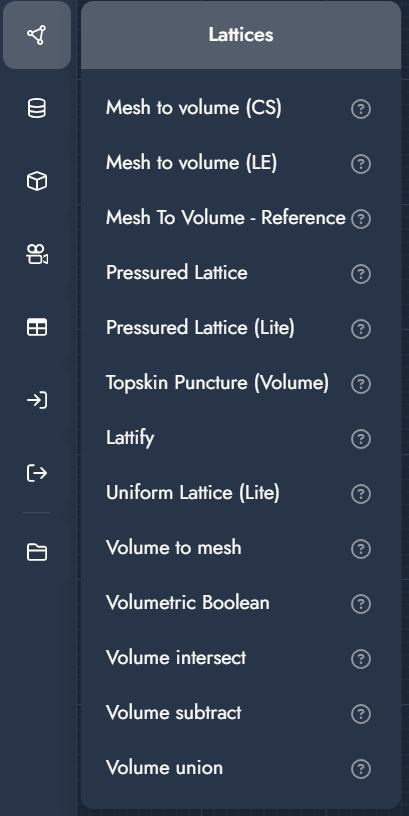
Lattice Modifiers
Lattice modifiers are used to generate, manipulate, and process volumetric lattice structures. They typically operate on volume data derived from meshes and allow the creation of lightweight, structural, or functional internal geometries.
Common use cases include weight reduction, structural optimization, and advanced manufacturing workflows such as 3D printing.
|
Modifier |
Description |
Input |
|---|---|---|
Mesh to volume (CS)
|
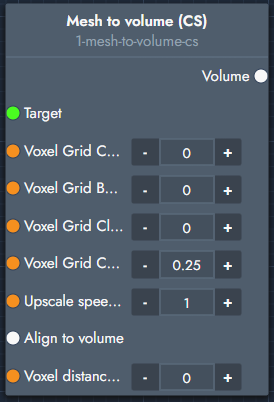
Converts a mesh into a volume to enable lattice generation, based on a voxel cell size parameter. The resulting volume is a three-dimensional grid where each cell is a voxel. Voxels are always cubic. |
Inputs
Outputs
|
Mesh to volume (LE)
|
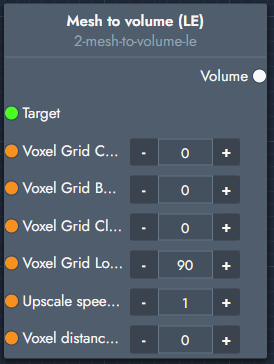
Converts a mesh into a volume based on the longest edge of the mesh. The longest dimension determines the voxel count, while the remaining dimensions are derived automatically using cubic voxels. |
Inputs
Outputs
|
Mesh To Volume - Reference
|
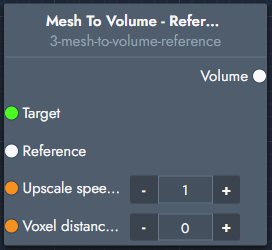
Converts mesh data to volume data using the dimensions of a reference volume. This allows perfect boolean operations between volumes. |
Inputs
Outputs
|
Pressured Lattice
|
Generates a lattice structure driven by a pressure map projected onto a volume. |
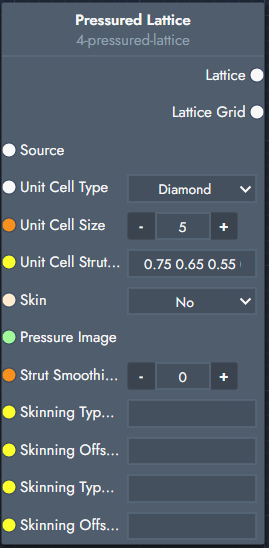
Inputs
Outputs
|
Pressured Lattice (Lite)
|
Lightweight version of the pressured lattice modifier with reduced parameters. |
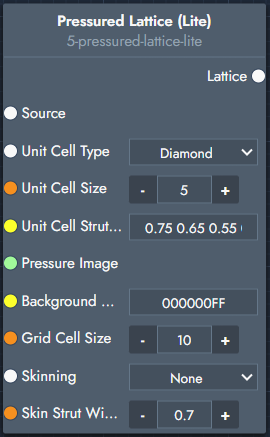
Inputs
Outputs
|
Topskin Puncture (Volume)
|
Creates punctures in the top skin of a lattice volume. |
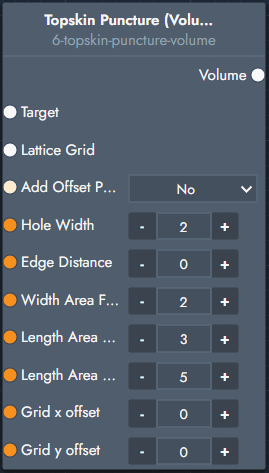
Inputs
Outputs
|
Lattify
|
Fills a volume with a uniform lattice structure. |
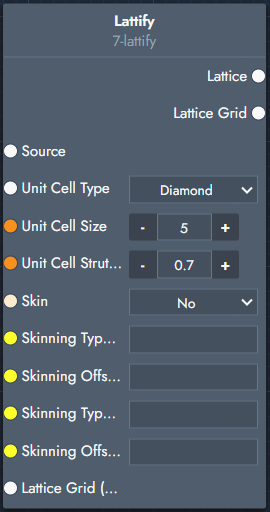
Inputs
Outputs
|
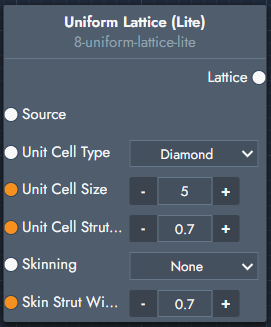
Uniform Lattice (Lite)
|
Creates a uniform lattice with simplified controls. |
Inputs
Outputs
|
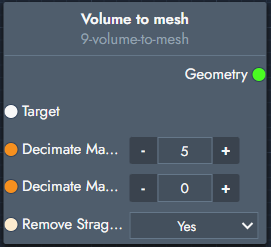
Volume to mesh
|
Converts a volume back into a mesh using the marching cubes algorithm. |
Inputs
Outputs
|
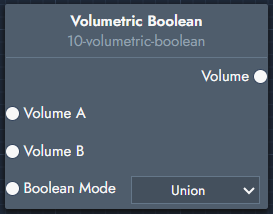
Volumetric Boolean
|
Performs boolean operations between two volumes. Inputs
Outputs
|
Inputs
Outputs
|